Formation
A young woman who enters the Filiæ Laboris Mariæ is introduced to the religious life gradually. The purpose of formation is to help her to know and understand the religious life and the particular life of our community, to grow in self-knowledge, in the interior life of prayer, and to prepare her to give herself to Jesus through Mary in the context of our community by means of the profession of vows.
Formation begins with entrance as a candidate. The candidate shares in the life of the novitiate, but she does not assume postulant garb. Upon becoming a postulant, she receives a navy-blue jumper dress with a white blouse and a black veil and is called “Sister,” though she keeps her baptismal name. Postulants are guided especially in their human and spiritual formation, as they learn about our life both through instruction, individual guidance, and through the experience of living our life.
After six to twelve months of postulancy, the postulant may ask to be invested with the holy habit and receive a religious name. In the ceremony in which she becomes a novice, the postulant dons a white wedding dress as a symbol of the gift she is making of herself to God. The novitiate lasts for two years, the first being the canonical year. The primary focus of the canonical year is the novice’s spiritual formation.
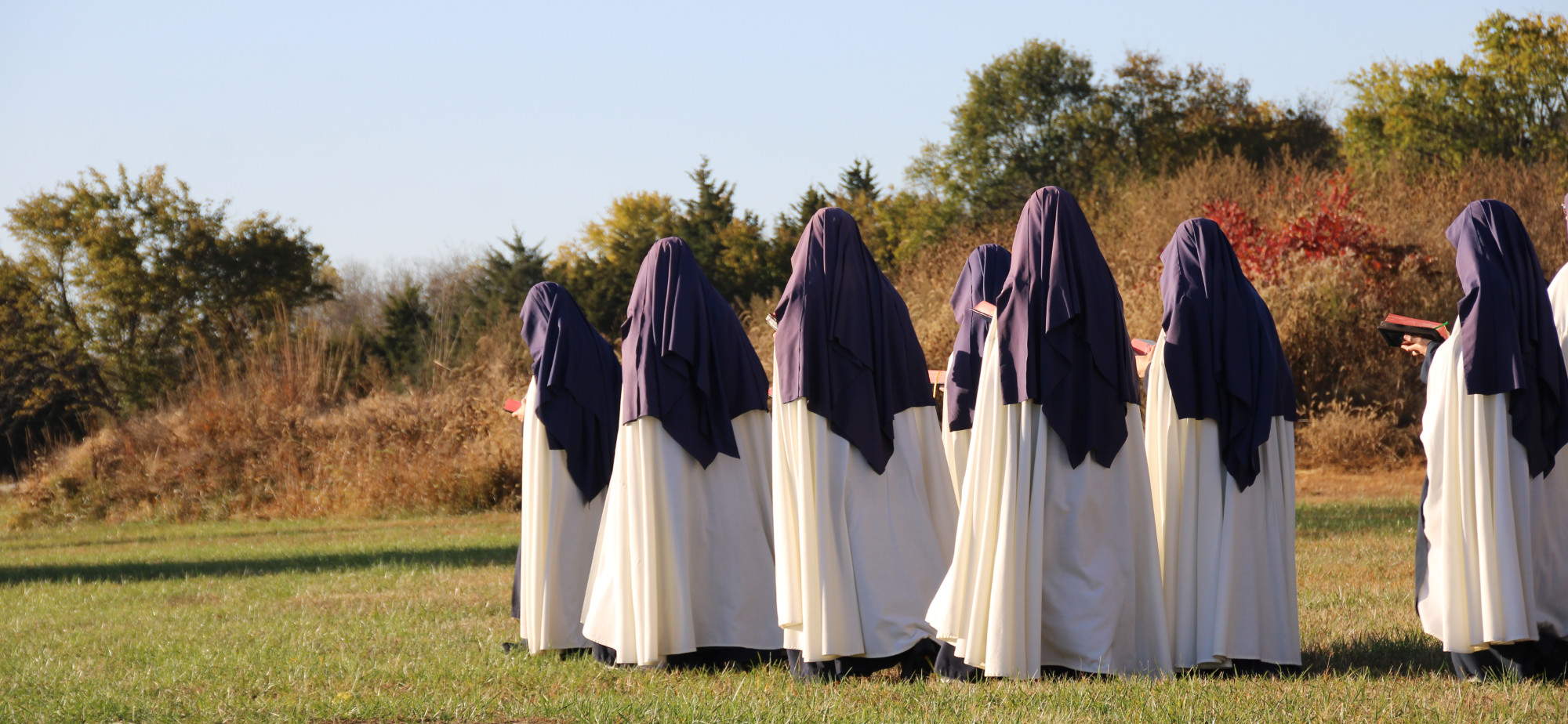
At the conclusion of the two-year novitiate, the novice makes her First Profession of Vows. In addition to the three evangelical counsels of poverty, chastity and obedience, the Filiæ Laboris Mariæ also profess a fourth Marian vow to live a life of total consecration to Jesus through Mary in a spirit of filial confidence and love. As the external sign of her profession, the Sister receives a navy blue veil in place of the white one she wore as a novice. She also receives the off-white choir mantle as part of her habit, and adds a title to her religious name. During the time of First Profession, the Sister deepens the formation she has received in the novitiate.
At the conclusion of at least three years of First Profession, a Sister makes her Perpetual Profession, vowing to give herself totally to God through our community forever. As an external sign of Perpetual Profession, the Sister wears a simple gold ring on her hand, signifying that she is bride of Christ.

History
The Filiæ Laboris Mariæ was founded on the Feast of Our Lady, Mother of Divine Grace (June 9th) in 2017, at Saint Mary’s Parish in Independence, Missouri, in the Diocese of Kansas City-Saint Joseph. Our community is a semi-contemplative Marian community, whose members live a rich liturgical and interior life and share those riches through some external apostolate, especially in the context of the parish.
Our current motherhouse, which includes the house of formation, is located in Redfield, Kansas. It is the intention that there will be foundations of daughters houses, typically located at or very near a parish.
Spirituality and Charism
“A great sign appeared in the sky, a woman clothed with the sun, with the moon under her feet, and on her head a crown of twelve stars. She was with child and wailed aloud in pain as she labored to give birth” (Rev 12:1).
The woman represented in the Apocalypse, symbolizes Our Lady, Mother of Divine Grace, assisting her Son in the work of restoring supernatural life to souls, is the inspiration for our way of life. We give ourselves to Our Lady to be her daughters, to assist her in her labors for souls, and thus to attain to union with the Most Blessed Trinity through charity.
We are first of all daughters of Mary. We live in company with Our Lady in a simple way, sharing our life with her, turning to her for counsel, and inviting her to form us as she formed her Son. The virtues proper to a Filia are faith, simplicity and filial confidence. Faith gives meaning to our hidden life of prayer, and our apostolic work. Our convent life and our external apostolate is characterized by simplicity. Simplicity reminds us of the “one thing necessary,” of integrity and of honesty. Our spirit is filial and, as daughters of Mary, we are confident in her.
As daughters of Mary, we are privileged to assist her in her work on behalf of souls. Our assistance is given in three main ways, which we refer to as our Three Labors: the Sacred Liturgy, the interior life and the apostolate.
Our three labors are modeled after the spirit of the Home of Nazareth. We seek to live the hidden life in the company and in imitation of Jesus, Mary and Joseph. Jesus leads us to the Father and gives us of His Spirit, thus drawing us into life with the Three—our ultimate end and desire. Like Our Lady, we are privileged to care for Jesus: Jesus in one another, Jesus in His priests, Jesus in all souls we serve.
The shield of the Filiæ Labor Mariæ consists of an “M,” symbol for Mary, surmounted by the cross, representing Jesus, and surrounded by twelve stars, as in Revelation 12:1. Below the M are the Hearts of Jesus and Mary, overlapping, as the two Hearts cannot be separated. The motto below the shield is “Sanare per caritatem”: to heal through charity. The motto describes our mission of assisting in the salvation of souls through charity, and the images of the Hearts illustrate how we do it: through the Hearts of Jesus and Mary. The work of Jesus and Mary has the sole purpose of healing through charity.
Apostolate
In our work, we imitate the life of the Holy Family at Nazareth, which was apostolic, both in the prayer which spanned the breadth of the world’s needs, and in external service. Just as Our Lady taught the Child Jesus at the home of Nazareth, so our apostolic service flows from our life with Jesus and Mary, and often includes the teaching of the faith. We seek to make our own the concerns of Jesus and Mary: We must be about our Father’s business. As in Our Lady’s Visitation, we seek to carry Jesus to those to whom we are sent, be it our Sisters in the convent or those outside the convent.
Since our life is devoted first of all to the Sacred Liturgy and to the interior life, the time we are able to dedicate to apostolic service is limited and, for that reason, the Filiæ Laboris Mariæ are fittingly called “semi-contemplative.”